
The world is drowning in t-shirts. By some estimates, 10% of greenhouse gas emissions are caused by clothing and footwear production. Then, once the clothing is produced, an estimated 85% of it ends up in a landfill or incinerator, even when it is still in good and wearable condition. The Boston Marathon, one of the world’s premier athletic events and a point of pride for all of New England, is making the problem worse. (Boston is hardly alone in this problem, but as I gear up for Marathon Monday, it’s where my head is.)
When I think about running the 2023 Boston Marathon on Marathon Monday, I picture eating a pre-race banana in the bustling Athletes’ Village and making my way to my start corral, sharing nervous and excited conversation and laughs with other runners. I imagine screaming Wellesley students at the halfway point. I dread Heartbreak Hill. I tear up when I think about turning right on Hereford and left on Boylston. I run Boston for those memories not for the shirt.
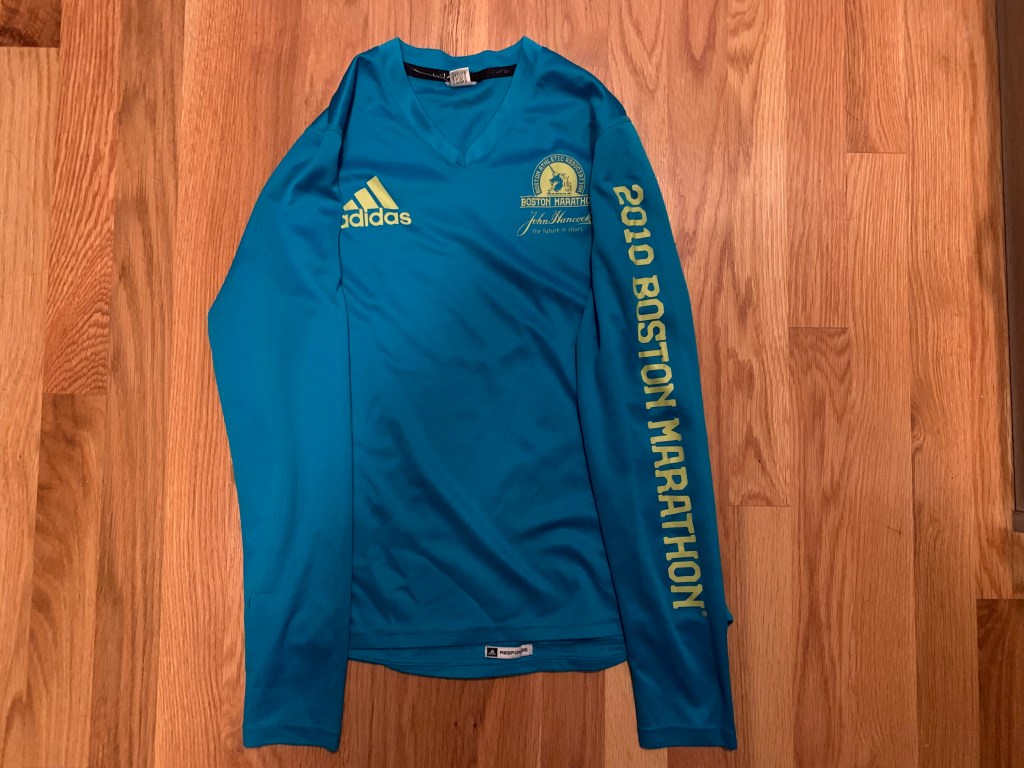
My ill-fitting 2010 shirt that will never biodegrade and will rarely, if ever, be worn
The reality is that my shirt from 2010 (the first time I ran Boston) sits unused in the back of my closet because it doesn’t fit right. And yet, the petroleum based shirt has a carbon footprint of approximately 12.1 lbs.* Even worse, my 2016 shirt got donated long ago because my drawers were overflowing with race shirts. That shirt is now likely sitting in a landfill far from Boston together with all of the shirts celebrating the Atlanta Falcons as the 2017 Super Bowl Champions.
Don’t get me wrong – I understand that for some runners, the Boston Marathon shirt is worth more than gold. There’s a reason that my ill-fitting 2010 shirt still sits in the closet – the sentimental attachment is real. But for each runner who cherishes that shirt, there is another runner who will never wear it. And each of those shirts went through a dirty production process and is en route to a landfill before long.
So why then does the Boston Marathon continue to make shirts for each of its over 30,000 participants?
The Boston Athletic Association, the Boston Marathon, and the race sponsors have another option. Give runners a choice at registration. I challenge the BAA to ask runners at registration to affirmatively opt-in to receive a shirt. If a runner opts in, fine. Only produce that number of shirts. If a runner does not, then do not make a shirt for that runner. Even better, partner with Trees Not Tees, an organization that works with races and race sponsors to plant a tree for each runner who opts out of a t-shirt. Win-win!
If you think the Boston Marathon is too big to do this or that it’s too complicated, it’s not. The TCS London Marathon has introduced a Trees Not Tees option for its participants. If London can do it, so can Boston. Especially on Patriot’s Day.
And what can participants do? This solution is also easy. Decline the shirt when you pick up your bib at the expo and write to the BAA and write to the Marathon sponsors (Bank of America is the new flagship sponsor starting in 2024) to tell them that you declined your shirt and want them to offer a Trees Not Tees option for 2024. That 2023 shirt has already been produced and so the impact is done, but the message you send is clear. Choose to make your Boston Marathon memories through camaraderie with fellow runners, a celebration of the charity you raised funds for, the sense of accomplishment at qualifying for this race. Not by filling up landfills.
I love Marathon Monday. I can’t wait to run my third Boston Marathon on April 17th. I also can’t wait to decline the shirt when I get to Hynes Convention Center to pick up my bib. Reducing race shirts is a small but very important way to reduce the footprint of running.
*The impact of 30,000 of these polyester shirts is equivalent to almost 1,500,000 million miles driven by an average gas-powered vehicle according to the EPA Greenhouse Gas Equivalency Calculator.
 The Green Ostrich
5 responses to “The World is Drowning in T-Shirts. The Boston Marathon is Making it Worse!”
Well said Caroline. Good luck at Boston. ??
Sent from Outlook for iOShttps://aka.ms/o0ukef ________________________________
LikeLike
Thank you!
LikeLike
[…] know I keep picking on Boston, but it’s been top of mind for me and sometimes it’s just too […]
LikeLike
[…] seems like I’m preaching this in every blog post, but don’t take the race t-shirt. If the race gives the option, opt-out of the shirt at […]
LikeLike
[…] of it, like this brand new/unworn singlet, ends up on EBay for a pretty penny. Much of it probably ends up in the trash along with most of our clothing after having been worn only a handful of times at […]
LikeLike