
Maybe you’ve heard the term “super shoes.” Maybe you’ve even heard about the new Adidas super shoe that just helped break the women’s world record in the marathon. The shoe has been getting a lot of press recently including a New York Times article this past weekend and a CBC interview on As It Happens with yours truly last week.
When I spoke to the CBC, the focus was partly on the huge price tag of this shoe ($500US/$650 Canadian), but, not surprisingly, the more important factor for me is the massive environmental cost of this shoe.
It’s bad enough that most running shoe brands make shoes that are advertised to be good for 300-500 miles (I’d argue they’re often good for longer than that, but I digress) and most super shoes are only good for 100-150 miles. But this shoe? This shoe is good for ONE marathon plus a couple of tune up runs. This is exactly the wrong direction for the shoe industry.
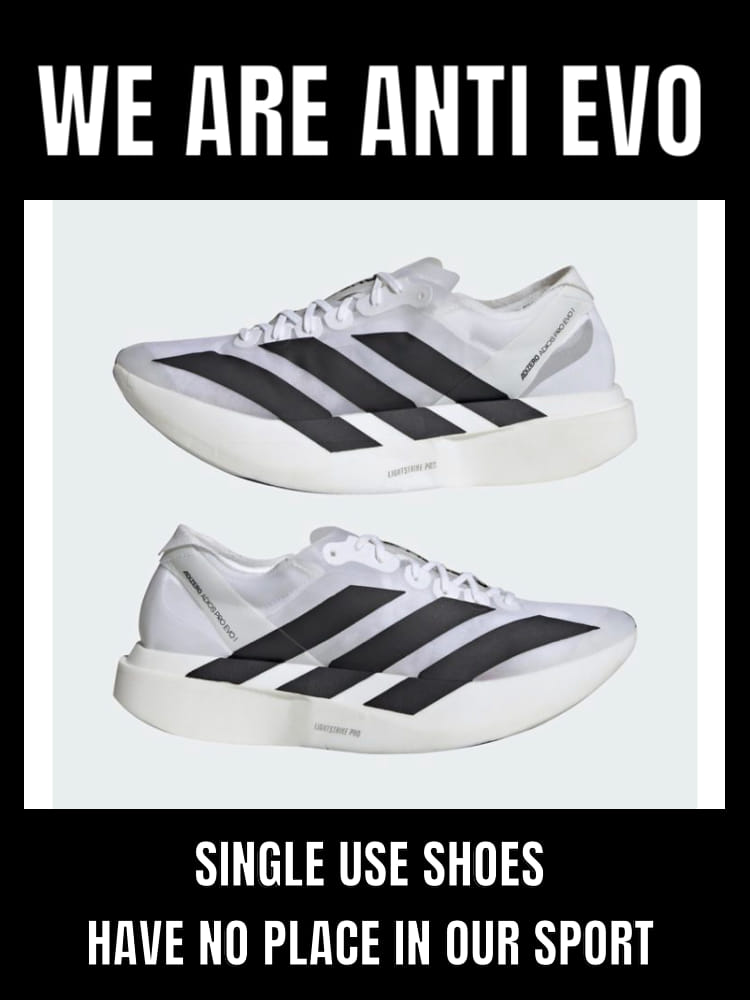
Running shoes have a huge environmental impact. According to MIT, a pair of running shoes has a carbon footprint of 30lbs of CO2 (this is for a standard pair of running shoes – I am not sure how the carbon impact for super shoes differs). And then Americans throw out 300 million pairs of shoes per year. And once thrown out, these shoes, which are made of all sorts of mixed materials including plastics, break up into tiny pieces eventually releasing microplastics into the ocean.
Instead of making a shoe that is only good for one race, the industry needs to be focused on durability and circularity. We need more shoes on the market that are designed to last longer, designed to be repaired, and designed to stay out of landfills. But how do we balance that with human nature – or, rather, runner nature? Many runners just want to go faster. Whether it’s sleeping an extra 30 minutes each night in the weeks leading up to a big race or wearing high tech/low durability shoes, runners are always looking for that extra edge. I don’t have all the answers. It’s easy for me to say, “Just don’t worry about your pace.” But that’s easier said than done. I’m guilty too – I want to run marathons faster. I care about my pace.
Even if I don’t have all the answers, I do have a couple of places to start.
First, the one I often come back to is consumer education. Educating runners about these shoes. For many runners, the environmental toll of these shoes may not be immediately apparent. But perhaps, once people learn about the impact, they will think twice about making this kind of purchase. Is this shoe really worth the potential for a faster time?
Second, I think that World Athletics has a potential role here. World Athletics governs the legality of shoes in races such as the marathon. There are all sorts of rules that are constantly changing as the arms race for the fastest shoe continues. What if World Athletics took durability into account? I may be dreaming here, but it doesn’t seem crazy to me that this could be added to the long list of parameters including stack height that the governing body looks at to determine if a shoe is allowed in competition.
Finally, I believe that regulation needs to change. Not just for super shoes but for all shoes and clothing. As the industry changes and more circularity and/or Extended Producer Responsibility laws are implemented, these shoes won’t make sense anymore. Brands will need to innovate – as they have been for the fastest shoe – to find new technology that makes shoes both fast AND durable.
I don’t blame runners here. I wish that people would take into consideration the environmental consequences of these shoes, but this is not exclusively a consumer issue. As with all of it, in addition to changing consumer mindset, we need to find ways to change the industry. It’s a multifaceted problem with multiple solutions. For now though, I just ask that before you go out and buy your next pair of marathon shoes, you take a minute to think about the total cost of those shoes beyond the dollars.
(Note: The Green Runners sent an open letter to Adidas that you can read here.)
 The Green Ostrich