
I spent a hot Saturday a couple of weeks ago walking around a local sculpture park in Lincoln, Massachusetts in the suburbs of Boston. The DeCordova Sculpture Park and Museum, which is owned by the Trustees of the Reservations, abuts conservation land with a vast trail network. We spent the morning wandering among the sculptures but also admiring the grounds. Complete with meadows of wildflowers and towering trees, this museum was not overly manicured. The art fits in with the landscape. The pollinators and frogs take up space alongside the humans. On the way home, we passed by our local National Park that goes through Concord, Lincoln, and Lexington, Massachusetts. The park is not only a celebration of the first battle of the Revolutionary War but also the site of my favorite tree, beautiful meadows, and a trail where I do some of my best running. Spending a Saturday enjoying nature in parks locally is a great reminder of the value of protected land. On a hot summer day, it also drove home the importance of access to green space.
Access to green space has important consequences for our physical and mental health and for the ecological health of the land. Throughout the United States, however, access to green space is not divided equally. You may have heard the term “Urban Heat Islands” (UHIs). UHIs refer to urban areas that are significantly hotter than their surrounding areas due to the built landscape and human activity. Asphalt roads, parking lots, and concrete buildings absorb and retain heat raising the air temperature. Combined with the impact of not having trees and vegetation, which provide both shade and a cooling effect from the evaporation of water off leaves, this can lead to UHIs having temperatures of ~10 degrees or more higher than nearby neighborhoods.
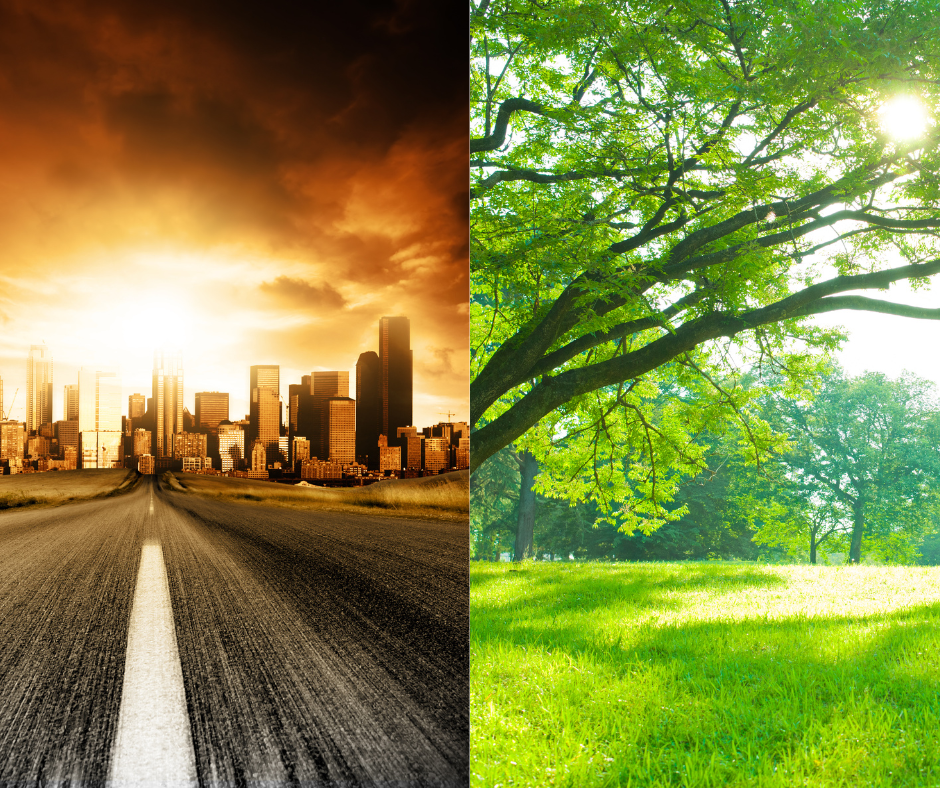
Looking at major cities in the United States, The New York Times showed in a telling piece that this is not an accident. Urban areas with limited tree cover, and therefore hotter temperatures, tend to follow along the same maps of formerly redlined neighborhoods. These neighborhoods, where highways sprang up instead of parks, remain among the poorest and most segregated neighborhoods in US cities and towns. They are also among the hottest. According to the article, wealthy areas have up to 65% more tree canopy than neighborhoods where 9 out of 10 residents live below the poverty line. This was abundantly clear as I wandered around the relatively wealthy, and very lush with trees, towns of Lincoln, Concord, and Lexington.
It’s important to note that UHIs are not causing warming – fossil fuels are doing that – but in an increasingly hot world, the impact of UHIs on local residents can range from extremely uncomfortable to downright dangerous. More green space in a community can mean cooler temperatures and better health outcomes across the board.
So What Can We Do About It?
We need to support efforts to cool urban spaces and to provide easier access to green spaces.
As a first action, we need to make sure that we know where the heat is the worst. Community scientists in Raleigh and Durham, North Carolina are mapping heat to find out which areas are most impacted. Others, like the New York Times article showed, may be mapping tree canopies. Is your community doing this?
Once we know the impact, we can take action. The Biden administration announced back in April that it would make $1 billion in grant money available to increase tree coverage in urban areas. Other efforts include finding ways to cool spaces through different roofing materials or even “green roofs” with vegetation, or, as in Los Angeles, by painting roads a lighter color to reflect the heat.
We also need to increase access to green space. This may mean better public transportation or more bike and walking lanes. In my local community, the Mystic River Watershed Association just received $1 million in grants to develop the parks along the Mystic River, which will increase access to green space for parts of Boston as well as urban neighborhoods in Everett, Somerville, and Chelsea. We need to find these efforts in our communities an advocate for them.
Most importantly, we need to bring in the communities most impacted by UHIs. As with any environmental justice effort, those most impacted need to have not only a seat at the table but a seat at the head of the table when thinking about any possible solutions. What is your city or town doing to address inequities in green space and UHIs and who is leading the discussions?
 The Green Ostrich