
I’m afraid of running injuries. In my teens and 20s, I spent too much time getting PT and not enough time putting in the miles. So when a shoe brand tells me to replace my shoes every few hundred miles (often 300-400 miles with Strava defaulting to a reminder at 250 miles), I’m inclined to listen. Or I was. Now, I’m working on change.
I’ve tried to find a concrete answer to the question of whether old running shoes will cause injury and, if so, how many miles I should be able to get out of them before I succumb to aches and pains. The answers, however, vary broadly. I’ve heard that running shoes lose most of their cushioning in the first 200 miles. By that logic, we should either replace our shoes after only 200 miles, or perhaps, if we get past 200 miles, we could go forever. I’ve heard that old shoes cause injury because whatever cushioning or stability they provide breaks down. I’ve also heard that old shoes do not cause injury or at least shouldn’t be blamed for most injuries. I think the answer is probably individual – What surface are you running on? Are you wearing shoes that are right for you? Are you wearing durable shoes? Are you a durable human? How much do you rely on the features of a shoe (like cushioning and stability)? But in any case, the answer about when to replace shoes should not be uniform and should not be based on an arbitrary standard that – upon reflection – seems focused on marketing and encouraging consumption.
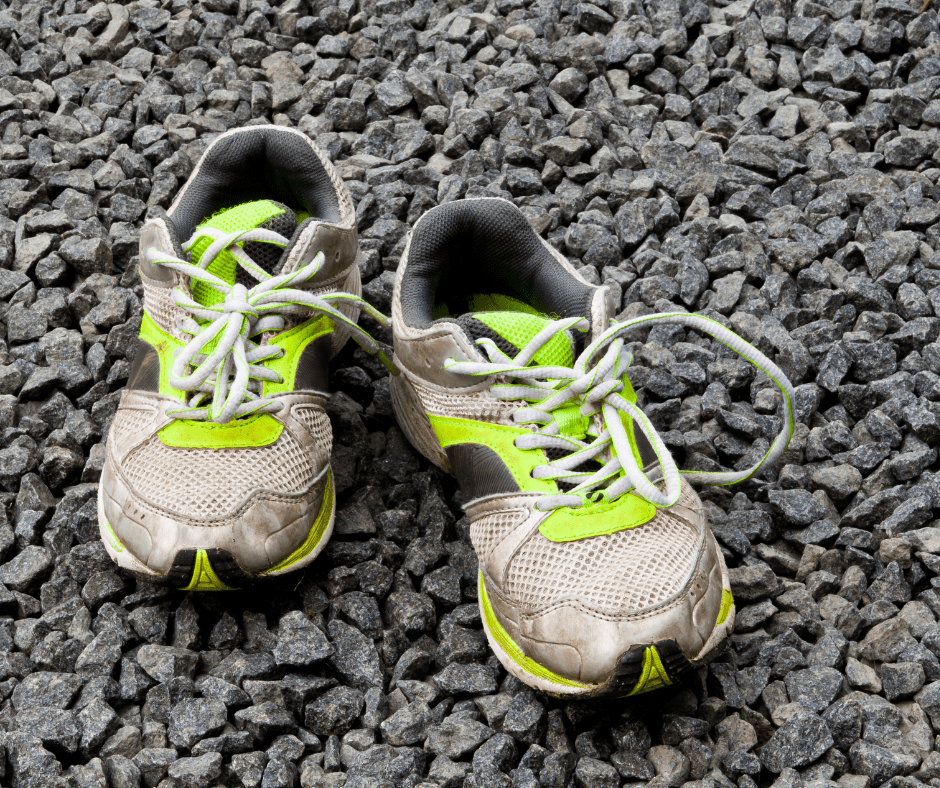
So as a runner, what do I do?
As I mentioned above, I used to replace my shoes as a matter of course out of fear. Often, I was right around 300 miles. Looking back, a lot of the shoes I replaced were still probably in excellent shape with tons of life left. Now, I’m much less conservative, and I go by feel.
I’m an occasional trail runner and my trail running shoes feel like they could go forever. With the soft surfaces that the trails provide, I don’t feel that they are breaking down at all. I have a feeling I’ll be holding onto my current trail shoes for a few years. And if the treads really break down, I’ll look into replacing just the soles. I never deal with holes in the uppers, but if I did, I’d repair those too (check out PairUps if you do deal with holes in the uppers!)
The majority of my running, however, is on roads so I’m pounding a lot. I do find that my road shoes stop feeling good earlier than my trail shoes. My rule of thumb now is that I start thinking about replacing my shoes if my feet or legs are aching in an unusual way towards the end of a long run. My current pair has almost 600 miles on them, and honestly they still feel as good as they did in the first hundred miles so I think we’ll keep going for a while longer.
But when we do need to replace running shoes, where should we get them and what should we do with old ones?
I’ve started researching options for getting shoes. I wasn’t always inclined to look for secondhand running shoes because of some – probably misguided – fear that those shoes will already be worn down to someone else’s foot and stride. But I did some digging on eBay and found tons of options of shoes that were only worn a couple of times or maybe not worn at all but the seller just missed the return window. If you know the shoe you want, it’s worth looking around for very gently used options.
I also recently discovered a resource in the US – Relay Run. Relay Run stocks overstock products as well as unused returns (a great alternative to brands trashing or burning returned stock!).
A more unique alternative is OnRunning’s subscription shoe that you keep for about 600 miles and then return for recycling and they send you a new pair. These dye-free shoes are built to be recycled and seemingly never end up in a landfill.
And as for my old shoes, I start by turning my running shoes into everyday shoes or walking shoes. I also, embarrassingly, have some old ones sitting around that I have yet to deal with. My plan for those is not to donate them – where they’re likely to be landfilled! – but rather to send them to Got Sneakers. Got Sneakers will resell or recycle (really downcycle but it’s better than a landfill) old sneakers. Some brands like NNormal and Hylo also accept shoes that are not their own for recycling (again, downcycling since shoes that aren’t built for recycling can’t be fully recycled into a new pair). But I might keep a pair or two to make flower planters or some other craft out of!
It’s not perfect. As runners, most of us won’t be able to use one pair of shoes for the rest of our running careers and everyone’s tolerance for old shoes is different, but as with anything, it’s about being conscientious about your consumption. Replace shoes only when necessary not when you *think* it should be necessary and replace shoes with secondhand alternatives when possible.
I’m curious, what’s the most mileage you’ve ever gotten out of a pair of shoes? I’m looking for inspiration!
 The Green Ostrich