
Last week I took a big picture look into the Boston Marathon’s sustainability claims and actions. This week, I want to look at what participants can do when they are running races – especially large road races.
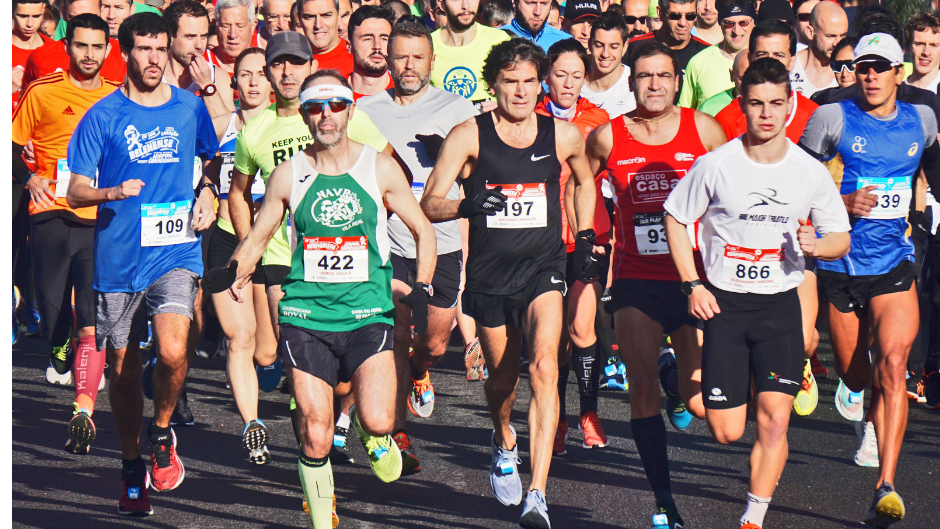
I’ll structure my thoughts around the 4 pillars for “running without the footprint” that The Green Runners has set out:
How We Move
How We Eat
How We Kit Up
How We Speak Out
How We Move
I should start by saying that this is the pillar that makes me feel most like a climate hypocrite (thank you Damian Hall for putting that phrase in my vocabulary). My own travel footprint is not breaking any low-carbon records, but I’m working to be more thoughtful about the choices I make. With that off my chest, let’s talk about participant travel to races. As I mentioned before, for many big city marathons, participant travel is the biggest source of emissions, and the biggest issue within that is participants flying to race. Big city marathons are so fun. They’re a great way to explore a new place and a new culture. But from an environmental perspective, it doesn’t make sense for us to fly to races.
So what should a runner do?
Consider whether this race is worth the emissions. The calculus may be different for every person and every race, but be honest with yourself when thinking about it.
Consider whether there is another race closer to home that gives you the same enjoyment. I live in Boston and close to New York. I’d love to run the London and Berlin marathons, but Boston and New York are pretty amazing and scratch the same itch for me as a marathoner. I don’t need to run London or Berlin to feel fulfilled as a runner.
Consider whether you can turn the race into a vacation and really explore a place. If you take one vacation per year, can you combine it with that bucket list race so that you are flying once for a longer period of time versus flying to a race and flying to your vacation?
Consider your travel beyond the flights. Using public transportation or carpooling can be a great way to reduce your travel footprint at races.
How We Eat
This pillar in general is largely focused on moving to or towards a plant-based diet, but it’s important in the context of racing as well. Unlike in the ultra and trail world, many marathon runners are not taking in “real food” during a race. I know that while I can happily eat a peanut butter and jelly sandwich during an ultra, my stomach can’t take in more than gel or sport drink during a faster-paced road race.
So what should a runner do?
Consider the packaging of any gels you take. Terracycle and Gu has a new recycling program for gel wrappers (they take any brand not just Gu brand). If you rely on energy gels during a race, take the packaging with you and send it back. It takes no more effort to throw the wrapper back into your sports bra or shorts pocket than it does to throw it on the ground.
Do research on the race to learn how fuel is being handed out on race day. At the Boston Marathon, for instance, water and Gatorade were in compostable cups, and at each aid station the cups were collected by volunteers into bins. As a runner, it’s important to know that the bins at the end of the table are for compostable cups not for trash like gel wrappers.
Don’t mindlessly grab everything at the finish line. Finish lines are often lined with food and drink at road races. If a race is handing out bottles of water and sport drink at the finish, don’t take it if you won’t eat or drink it. Even better, if there is a finish-line drop bag option, put your post-race food and drink in that in reusable containers so you don’t have to take the finish-line plastic bottles and individually wrapped snacks.
How We Kit Up
It seems like I’m preaching this in every blog post, but don’t take the race t-shirt. If the race gives the option, opt-out of the shirt at registration. If the race doesn’t give the option, opt out at the expo and explain to the volunteers and organizers why you are doing so.
There’s a lot more to kitting up through training, but purely from the race perspective, I’d love to see more runners opting out of race t-shirts and other swag.
How We Speak Out
This is arguably the most important pillar. As a runner, research what the race organizers are and are not doing and speak out. Tell them what you want to see. Offer resources. Offer to volunteer your time to make the change you want to see. Encourage others to speak out.
In a recent webinar that I attended (Running from Waste put on by the Sport Ecology Group), the Heads of Sustainability for New York Road Runners (that puts on the NYC Marathon) and the London Marathon both made the point that when people speak out, it makes it easier for them to respond and make their case to their respective organizations. We’ve also seen the Boston Athletic Association respond to the community speaking out on other issues. The BAA now offers a pregnancy deferral for the Boston Marathon and added a non-binary category. These actions happened because of racers speaking out and advocating for change.
Most importantly, recognize that imperfect action is better than no action. Maybe you have to have that water right at the finish and so you take the plastic bottle. OK – I’m not advocating dehydration or a dangerous post-race medical event. But dispose of it properly. Maybe running this race is on your bucket list and that shirt is worth its weight in gold to you. OK – take the shirt. Then wear it. A lot. And with pride. Maybe you’ve always dreamed of a certain international race. OK – fly to that race but make changes elsewhere. We aren’t perfect. We aren’t expected to be perfect. But it matters that we are thoughtful in our choices, get educated about our options, and make changes where we can.
 The Green Ostrich