
This is not your typical post-race report. Instead of talking about my own race in Boston, I want to address sustainability at the Boston Marathon. This is a long one – sorry. This is also just the the first part. Today, I’m looking big-picture at what the Boston Athletic Association (BAA) is doing, should be doing, and can do. Next week, I’ll look at what participants can and should be thinking about when they race.
I know I keep picking on Boston, but it’s been top of mind for me and I so badly want the Boston Marathon to be a leader in this space!
Anyone who has had a conversation with me on the topic knows that I’ve been disappointed by the lack of any visible effort to address sustainability by the BAA so I was encouraged when I read an article in Outside addressing how the race is embracing sustainability. I did question some of the claims – you can probably guess how I feel about Adidas’ “sustainable” celebration jacket. If you can’t, read this post for a hint. Other claims are more promising. After hearing that many big city marathons across the pond (I’m looking at you Paris and London) use plastic bottles along the course, I’m thrilled that the BAA is using compostable cups.
Since there isn’t much information online about sustainability efforts beyond that article, I was really excited to see what else I could learn at the expo. Spoiler alert – not much, unfortunately.
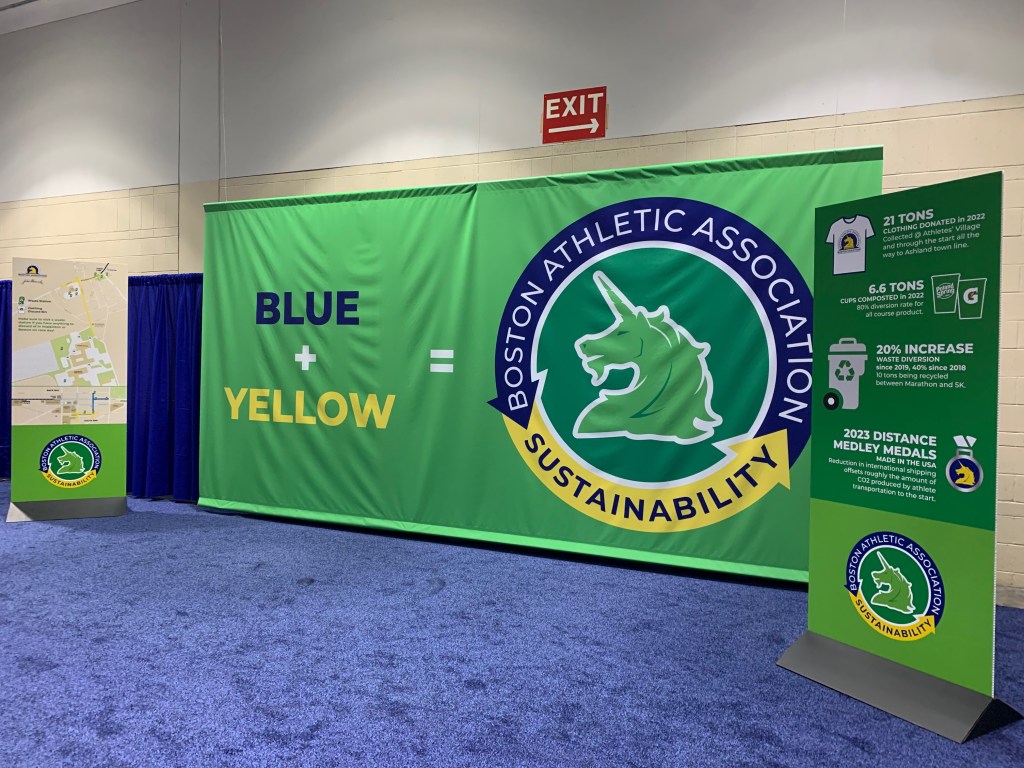
After picking up my number – and thoroughly confusing the volunteers when I told them I didn’t want the plastic bag of stuff or the t-shirt – I walked around the conference center looking for information on sustainability. I found a very sorry looking booth that was not only unmanned but also gave limited information.
Take a look!
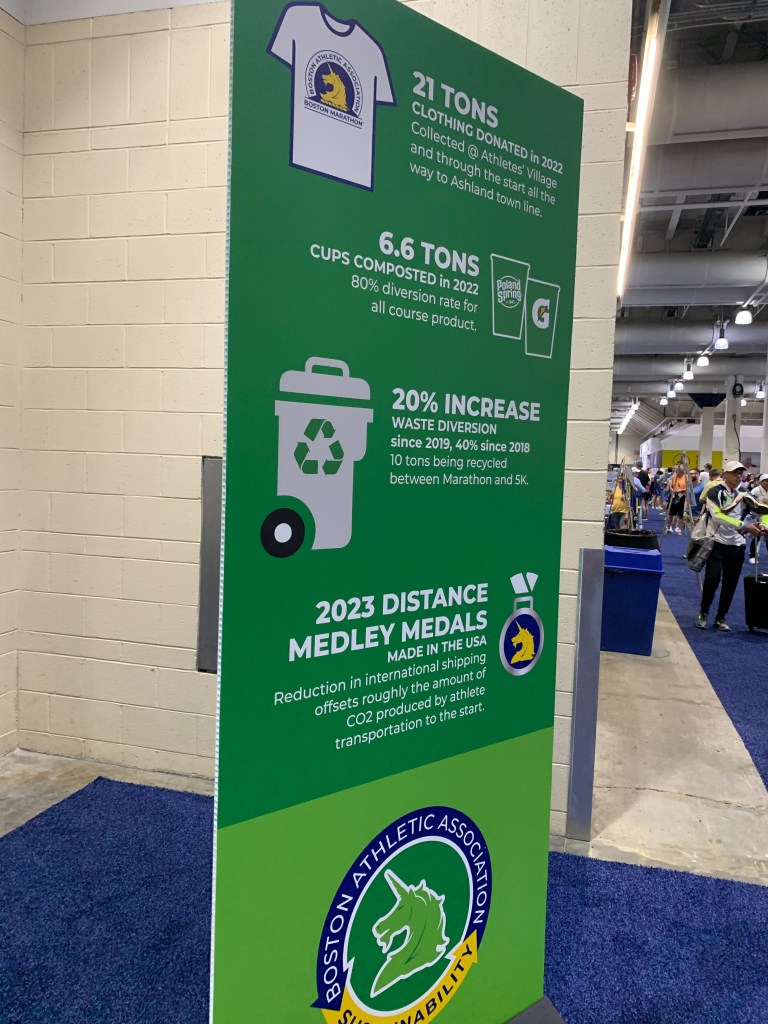
So let’s break down these claims:
Blue + Yellow = Sustainability
OK. First of all, just because you can mix blue and yellow together to make green does not make the event green. I does, however, work as a marketing tactic. I overheard one couple walk by and say, “Oh, they’re doing that sustainability thing.” Yikes!
2023 Distance Medley Medal Claim
In the interest of starting with the bad news, I’m going to address the last claim up front. First of all, let’s be clear about what medals we’re talking about. The BAA hosts multiple events throughout the year including the Marathon, a half marathon, a 10K, a 5K, and a host of others. Runners can sign up for the Distance Medley which means they are running the half marathon, 10K and 5K all in the same year. If they do that, they get a special medal and a special ranking. (Side note: it’s a great way to run some really fun races!) The medals referenced here are NOT the marathon medals nor are they the half marathon, 10K, 5K, or other event medals. They are only the special medals for people who sign up for the Distance Medley.
And the claim itself? I found it confusing. Do they mean the CO2 produced by all athletes at all of their events? Or just the distance medley athletes? Or something else? And what transportation? From the start-line shuttles or the average distance traveled by athletes from their homes? This claim lacks substance and I’d love to understand the background.
21 Tons of Clothing donated in 2022
This is a hard one and in some ways, the marathon organizers are between a rock and a hard place. The early morning hours in April in Boston can be very cold (this year was both cold and rainy) and so runners need warm-up clothes at the Athletes’ Village. And because of the logistics of the race starting 26.2 miles away from the finish on a point-to-point course together with the logistics of bag drops for security reasons, shuttling warm-up clothes from the start to the finish for pick up isn’t a feasible option. But we also know that 85% of donated clothing ends up in landfills or incinerated. The perfect solution doesn’t exist, but I do hope that Big Brothers Big Sisters, the organization the BAA partners with, is making thoughtful decisions on what they do with the clothes that are donated. I will say that the race volunteers at the Athletes’ Village and at the start line did a pretty good job collecting clothes and informing racers which bags were clothing donation bags and which bags were trash bags. I was pleased to see this.
6.6 Tons of Cups Composted in 2022
As mentioned above, I’m happy with this one. Along the course, volunteers were doing a good job collecting the cups from the street with rakes and putting them in the compostable bags. I’m sure that some runner gel packets got mixed in with these bags. Maybe some more education around this would help avoid mixing or not having bins at all. It seems counter-intuitive, but if all of our waste ends up on the ground, the volunteers may be able to sort it better than if the compost bin gets contaminated by gel wrappers because runners mindlessly throw their wrappers in the bin. Overall though, this is far preferable to plastic bottles littering the course, and as a runner, I’d much rather grab a cup to drink from than risk twisting an ankle on a bottle on the ground.
They did, however, hand out plastic water bottles to runners at the finish together with a plastic bag that looked like it was full of food and a Gatorade bottle. It’s one thing to address the plastic waste along the course, but the next step should be addressing it at the expo and the finish.
20% Increase in Waste Diversion since 2019
I dislike claims that only address a percent increase because we don’t know what the starting point is but they do give a weight of materials recycled. The Athletes’ Village was pretty well set up in this respect. They had multiple waste stations with volunteers. Instead of putting out bins, they asked racers to put their waste on tables where the volunteers could then sort it into the appropriate containers. In theory, they were doing well on this though I can’t say whether all items got sorted where they should (like did that still-wrapped granola bar that the runner didn’t eat pre-race get opened so the bar could be composted or did the whole thing go in trash since it was mixed food and a non-recyclable wrapper?).
What is Boston not addressing?
Big city marathons like the Boston Marathon have huge emissions. While the cups or bottles on the street is the thing that runners focus most on because it’s so obvious to the naked eye, the marathon needs to be focusing on other issues as well. Here are a few of them.
T-Shirts
We know my stance on t-shirts. I won’t rehash it again except to say that I’d like to see the Boston Marathon offer an opt-out.
Travel
Participant travel tends to be the biggest source of emissions at these races – especially a race like Boston that has significant international participation and participation from across the United States. I don’t have a number for Boston, but the Paris Marathon calculated that over 90% of its race emissions were from participant travel. Is the BAA doing anything to address participant travel? It’s a hard one – short of putting quotas on non-local participation (which I understand is not an option), travel is perhaps considered outside the scope of the event, but race organizers need to be talking about it, educating participants, and thinking creatively.
Signage
The BAA has a lot of signage. For instance, every year, the BAA puts up commemorative banners on light poles around the city with iconic images of the race. Each year the banners have a different theme. The banners make me tear up. I love them. But I wonder what happens to them at the end of the year. Are they trashed? I’d love to see the BAA find a way to move towards reusable banners. This has to be done creatively as the images can’t necessarily change annually, but the potential waste of the current banners is problematic.
Race Sponsorship
Another tricky issue. The BAA is a non-profit organization. So is New York Road Runners, the organization that puts on the New York City Marathon. They need sponsors and they need sponsors with deep pockets. Often, this means financial institutions. I don’t want go deep on this today, but it’s worth wondering whether the BAA considered sustainability when it signed on Bank of America as lead sponsor starting in 2024.
What’s next? Maybe it’s time for a sustainability director.
Based on the lack of visible efforts from the BAA, I was prepared to go into race weekend and see nothing positive. I was proved wrong in some respects, but there’s still work to be don. I would encourage the BAA to bring on a sustainability director. I understand that resources are thin for a small non-profit. I’m not naive enough to believe that this is a simple option for the BAA, but I hope that the organization sees it as an important priority. Currently, it seems that there is no one tasked with this job full-time and so it is falling on the operations team that has other priorities. That’s not good enough anymore.
 The Green Ostrich
One response to “Boston Marathon Race Report – Sustainability Edition (Part 1)”
[…] week I took a big picture look into the Boston Marathon’s sustainability claims and actions. This week, I want to look at what participants can do when they are running races – […]
LikeLike